

As published on 26th June, 2026 in Stuff, authored by Steve Kilgallon,. Read the original article here: “Doctor arrested at airport over $180,000 student loan debt”
A NZ student loan border arrest at Wellington Airport has sent a stark, undeniable warning to tens of thousands of New Zealanders living abroad: Inland Revenue (IRD) is sharply intensifying its enforcement on defaulted student loans, using border detentions as a direct measure of last resort.
Recently, an overseas-based medical doctor attempting to board a flight home to Australia was intercepted and arrested by New Zealand Police at Wellington Airport. The cause? A decades-old student loan balance that, fueled by compounding interest and accumulated non-payment penalties, had ballooned to approximately $180,000.
The high-profile arrest highlights a stark and growing rift between overseas Kiwis and IRD compliance. Inland Revenue records show that over 113,000 borrowers currently reside overseas, with roughly 70 percent sitting in default. Together, these expatriates collectively owe around $2.5 billion. Alarmingly, more than $1 billion of that total consists strictly of accrued penalties and interest rather than the original principal. For over 24,000 of these borrowers, the debt has been quietly compounding in the background for more than 15 years.
The Snowball Effect: How Penalties Hijack Debt
Former IRD prosecutor turned tax defense barrister Dave Ananth, who represented the doctor in court following his detention, warns that overseas borrowers routinely underestimate how rapidly an unmanaged student loan explodes.
“They thought, ‘Okay, we’ll come back to the student loan a little later when things settle down’—that never happens,” Ananth explained. “Then after 15 or 20 years, you get a massive bill from IRD.”
Ananth noted that while tertiary loans remain interest-free for borrowers living in New Zealand, the financial rules change drastically the moment a graduate resides abroad for more than 184 days. The interest rate for overseas borrowers sits at 5.6 percent, with late payment penalties adding another 9.6 percent—compounded daily. Under these compounding structures, an initial $30,000 loan left unattended for 20 years can easily snowball into a $120,000 to $180,000 liability.
In many cases, life circumstances—rather than intentional evasion—cause individuals to slip behind. “None of them have said, ‘Look, I’m not paying my student loan.’ It’s a lot of remorse… things didn’t work out,” Ananth observed, citing divorces, family breakups, sudden illnesses, and job losses as common personal catalysts that lead people to bury their heads in the sand until a crisis occurs.
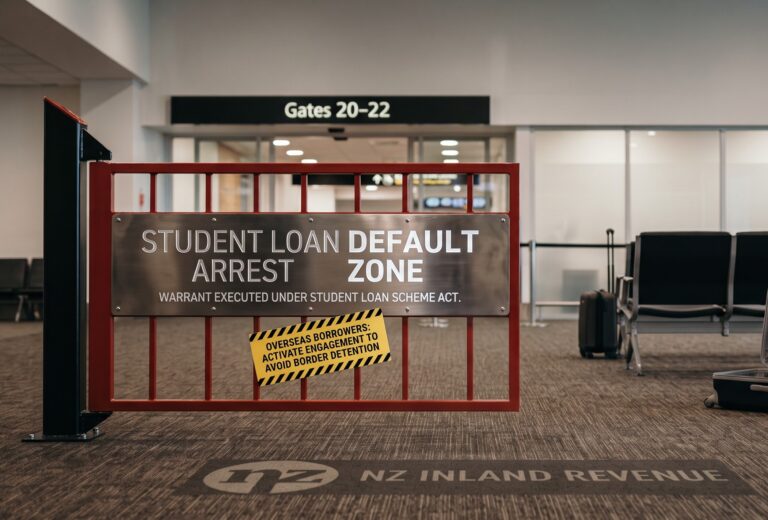
How Border Tracking and Arrest Warrants Work
With dedicated government funding aimed at debt recovery, Inland Revenue has signaled a permanent shift toward aggressive enforcement at international gateways. Through integrated database sharing, New Zealand Customs automatically alerts IRD the instant a targeted borrower scans their passport or checks in for a flight.
If a borrower has consistently refused to communicate or make repayment arrangements, IRD can apply to a District Court judge for a warrant for arrest under the Student Loan Scheme Act. Executed directly by police officers inside airport terminal gates, the warrant prevents the traveler from departing New Zealand until they are brought before a judge to enter a binding repayment agreement or provide adequate security.
Inland Revenue confirmed it actively monitors over 150 high-priority overseas borrowers carrying a combined default exceeding $15 million, while simultaneously keeping close tabs on more than 300 defaulted borrowers who hold residential property or commercial investments within New Zealand.
Legal Options to Prevent an NZ Student Loan Border Arrest
Despite the traumatic prospect of facing a student loan border arrest, Ananth emphasizes that viable legal pathways exist for expatriates who choose to address their position proactively rather than waiting for an airport confrontation.
“There are provisions, but what I’m saying is, engage,” Ananth stressed. He pointed out that under statutory provisions, IRD retains administrative flexibility to grant significant remissions on accrued interest and penalties for individuals who step forward voluntarily to negotiate structured settlements. “Ultimately, I think it’s a student loan debt, it’s taxpayer-funded, you’ve got to pay it back.”
For expatriates living in Australia, the UK, or further afield, ignoring an overdue balance only guarantees that penalties will continue to compound daily. If you reside overseas, hold an outstanding loan default, and are planning travel to or through New Zealand, engaging experienced legal and tax advocacy before booking your travel is the single best way to avoid a student loan border arrest, negotiate debt relief, and secure guaranteed safe passage.

Further Reading & Resources
For more information and legal commentary regarding the complexities of debt management and the legal obligations surrounding education funding, you can explore the following student loan articles:
-
I Live in Australia and My NZ Student Loan Has Doubled — What Can I Do?
A practical guide for expatriates living in Australia who return to find their balance doubled or tripled, outlining clear step-by-step pathways to engage with IRD.
-
Can IRD Arrest Me at the Border Over My Student Loan?
An essential legal breakdown addressing border detention risks, the statutory conditions for high-priority warrants, and how to verify your status before traveling.
-
IRD Fails to Communicate Student Loan Interest Rate Changes to Kiwis Living Abroad
Coverage from AUT’s Te Waha Nui featuring Dave Ananth’s commentary on interest rate adjustments for overseas Kiwis and systemic gaps in IRD’s communication approach.
-
Dave Ananth Says Student Loan Repayment Obligations Are Often Much Tougher Than They Seem
A media commentary originally published on Interest.co.nz highlighting how rigid repayment schedules hit graduates well before they achieve financial stability.
-
The Critical Case for Reforming Student Loan Interest: Why Flexibility is Essential
An analysis of why student loan interest carries immense weight for thousands of New Zealanders and why a more flexible remission policy is necessary to recover debt.
-
“Dave Ananth on RNZ Nine to Noon — IRD Cracks Down on Overseas Student Loan Debt.” A summary of Dave’s discussion on Radio New Zealand regarding the Inland Revenue’s increasing enforcement measures for borrowers living abroad.
-
“Dave Ananth – Commentary on Student Loan Enforcement.” A feature from Newstalk ZB discussing how a hardline stance on student loans can often backfire on both the borrower and the system.