
Originally published in Free Malaysia Today on 17 August 2026.
The ongoing national debate surrounding consumption tax reform has once again taken center stage in Putrajaya. While fiscal pressures mount, policymakers continue to hesitate, stating that bringing back the Goods and Services Tax (GST) should wait until median wages reach RM4,000. While this argument sounds compassionate on the surface, it reflects backwards economic logic. The reality is simple: Malaysia needs GST to secure a sustainable fiscal foundation and fund the very public services, infrastructure, and wage growth the nation aspires to achieve.
In this detailed analysis, tax specialist Dave Ananth, former tax director with EY Malaysia and currently a partner at Meridian Partners in New Zealand, breaks down why postponing tax reform weakens the economy, examines the systemic failures of the Sales and Service Tax (SST), and outlines the essential compact of trust required for a successful Malaysia GST reintroduction.
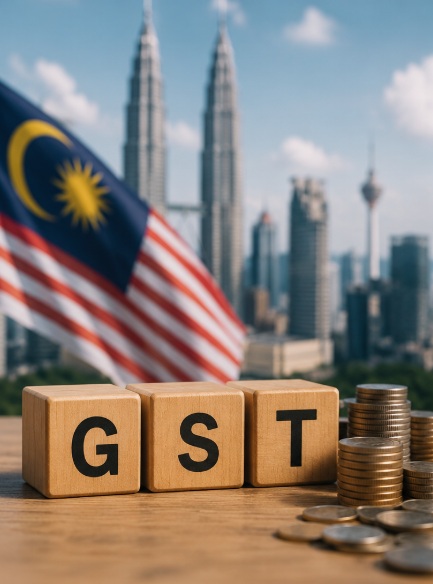
Why Malaysia Needs GST: The Narrow Tax Base Dilemma
Malaysia’s public finances are heavily constrained by an excessively narrow revenue structure. The nation cannot indefinitely support first-world public healthcare, modern infrastructure, and social safety nets on volatile petroleum dividends, corporate taxes, and the contributions of the small minority of workers who fall into the personal income tax net.
As Ananth highlights:
“Malaysia cannot fund better services through corporate income tax, petroleum revenue, and the few workers paying personal income tax. Malaysia needs a broad-based consumption tax again. But it cannot simply revive the 2014 GST model and expect acceptance. First, the government must confront why GST became so deeply distrusted.”
A consumption tax touches the entire formal and informal economy, ensuring that revenue expands predictably alongside national consumption. Without broadening the tax base, every future fiscal shock forces the government either to accumulate debt or rely on patchwork adjustments that distort market activity. Malaysia needs GST because national ambitions have outgrown the antiquated revenue systems tasked with financing them.
GST vs SST Malaysia: Why Sales Tax Expansion Fails
Following the repeal of GST in 2018, Malaysia reverted to the Sales and Service Tax (SST). Over recent budgets, authorities have attempted to close the fiscal deficit by broadening SST coverage, lowering thresholds, and raising service tax rates. However, expanding an inherently flawed single-stage tax creates substantial structural economic friction.
When evaluating GST vs SST Malaysia, the fundamental divergence lies in transparency and input tax recovery:
- The Cascading “Tax on Tax” Effect: SST lacks a mechanism for businesses to offset input taxes incurred during production and distribution. Consequently, taxes compound at each link in the supply chain, embedding hidden costs into final retail pricing that consumers pay without realizing it.
- Distortionary Complexity: Expanding SST turns tax administration into an arbitrary maze of sector-specific exemptions, threshold adjustments, and classification disputes.
- Diminished Transparency: Unlike GST’s self-policing audit trail, SST relies heavily on subjective definitions, opening loopholes while producing lower, less stable yields.
Ananth explains the policy contradiction clearly:
“Unlike GST, SST has no mechanism for recovering tax incurred on business inputs. Tax can become embedded and cascade through supply chains, with consumers unable to see how much is hidden in the final price. As SST expands, it increasingly depends on classifications, thresholds, exemptions and sector-specific rules. Malaysia is trying to reproduce GST’s breadth through a less transparent and less coherent system.”
Understanding the 2015 Backlash: A Deficit of Public Trust
To understand why a Malaysia GST reintroduction faces skepticism, one must objectively evaluate the 2015 rollout. Implemented at 6% on April 1, 2015, the tax arrived during a period of acute political turbulence and public skepticism regarding government expenditure.
The public pushback stemmed primarily from three administrative and political breakdowns:
- Flawed Public Messaging: The public communication campaign leaned too heavily on abstract macroeconomic rationale while failing to clearly explain safety nets and zero-rated household essentials.
- A Severe Deficit of Trust: Broad governance concerns caused citizens to view the new tax not as national development funding, but as an unjustified financial squeeze on working families.
- Severe Refund Mechanism Delays: Delays in processing billions of ringgit in input tax refunds severely disrupted commercial cash flow, forcing businesses to pass those operational costs down to consumers through higher shelf prices.
Ananth, who was professionally engaged during the initial implementation, reflects on the breakdown in communication and administration:
“The economic case was stronger than the public explanation. GST was the largest tax change in a generation, but many Malaysians never understood why it was necessary, how it worked or how poorer households would be protected… Delayed refunds turn GST into a working-capital cost passed to consumers. Its abolition was politically understandable, even if economically shortsighted.”
When businesses suffered through delayed refund disbursements, GST ceased to be viewed merely as an efficient technical mechanism; it became an operational burden for enterprises and an easy political target for opposition rhetoric.
The RM4,000 Median Wage Condition: Sound Policy or Political Shield?
The political stance that GST must wait until national median wages reach RM4,000 creates a circular trap. A nation cannot generate sustainable, high-income economic conditions without first funding the world-class education, technical training, digital connectivity, and public infrastructure that drive productivity.
“The government says Malaysia must first achieve higher wages before securing the revenue needed to help build a higher-wage economy. Waiting for RM4,000 is not responsible caution. It is a politically convenient way of postponing a difficult decision.”
Waiting for arbitrary wage milestones before executing structural tax reform functions as an excuse for inaction. Structural economic transitions require fiscal foresight and proactive execution rather than indefinite delays.

The Blueprint for Malaysia GST Reintroduction: Building a Credible Compact
Reinstating consumption tax cannot mean dusting off the old 2014 blueprint and repeating past missteps. For Malaysia GST reintroduction to gain national acceptance, it must be structured around fairness, operational speed, and fiscal accountability.
- Direct and Pre-Emptive Social Safeguards
GST in isolation is inherently regressive because low-income households spend a larger proportion of their earnings on immediate consumption. Tax advocates must acknowledge this reality openly. The remedy is targeted cash transfers (such as expanded Rahmah cash aid) funded directly by GST revenues and distributed before the tax takes effect.
- Modest Starting Rates with Minimal Exemptions
Launching with a lower introductory rate (such as 3% or 4%) fixed for a predetermined timeframe eases the macroeconomic adjustment period. Essential staples must remain protected, but the zero-rated list must remain concise to avoid eroding the tax base and creating unnecessary compliance friction.
- Guaranteed, Automated Refund Timelines
Refund delays must be structurally eliminated. Input tax refund reserves must be ring-fenced legally and managed via automated digital processes to prevent corporate cash-flow bottlenecks.
- Transparent Public Accounting
The public must see tangible returns on their contributions. Regular, transparent reporting on where consumption tax revenue is allocated—specifically toward hospitals, schools, and local transport networks—is vital to maintaining public goodwill.
Repairing Trust to Move the Nation Forward
The technical merits of consumption tax are indisputable among economists worldwide. However, technical superiority alone cannot replace civic confidence.
As Ananth summarizes:
“The first GST failed politically because a major technical reform was introduced into a deficit of trust. The next GST must be a compact: citizens contribute broadly, vulnerable households are protected, businesses receive refunds promptly, and government accounts openly for every ringgit. Once that compact is credible, waiting for an arbitrary wage figure is not economic policy. It is an excuse for doing nothing.”
Malaysia needs GST again—not as an imposition on working families, but as a fair, balanced, and transparent fiscal pillar designed to build a prosperous and resilient economy.